


The JET Programme is one of the largest exchange programmes in the world, having flourished due to receiving wide support from many organisations, most notably the Ministry of Internal Affairs and Communications (MIC), the Ministry of Foreign Affairs (MOFA), the Ministry of Education, Culture, Sports, Science and Technology (MEXT), and the Council of Local Authorities for International Relations (CLAIR).
The support of CLAIR and the three Ministries to both JET Programme participants and the institutions that host them is essential to the smooth operation of the programme.
Structure of the JET Programme

MIC, MOFA, MEXT
Financial measures, recruitment and
selection,education training,etc.
- Financial measures by the Ministry of Internal Affairs and Communications (MIC)
- Recruitment and selection by Ministry of Foreign Affairs (MOFA)
- Education training by Ministry of Education, Culture, Sports, Science and Technology (MEXT)

Council of Local Authorities
for International Relations (CLAIR)
JET Programme Administration
- Oversee correspondence with the Ministries involved with recruitment and selection of new JET participants
- Place JET Programme participants in contracting organisations
- Prepare and implement travel arrangements for participants, orientations and conferences such as Post-Arrival Orientation, and Japanese language courses
- Implement nationwide training for JET participants and publishing official handbooks
- Provide assistance and guidance to contracting organisations, FAQ manuals, and publication of official magazines
- Career support for JET participants
- Information distribution (e.g., CLAIR News emails)

Host Prefectures &
Designated Cities46 prefectures and 18 designated cities
Coordinating and providing support for
how contracting organisations in its
jurisdiction utilise the JET Programme
- Implement prefectural orientations
- Coordinate of appointment and reappointment of JET Programme participants
- Placement of Prefectural Advisors (PAs) to provide consultation and information to JET Programme participants
- Implement training within the prefecture or designated city
- Plan and implement ALT Skills Development Conferences
- Host seminars for contracting organisations
Supporting Organisations

Council of Local Authorities for International Relations(CLAIR)
The Council of Local Authorities for International Relations (CLAIR) manages the JET Programme in conjunction with the three Ministries. CLAIR was established as a joint organisation of prefectural and municipal governments in July 1988, to promote and provide support for an increasing interest in grassroots internationalisation in Japan.
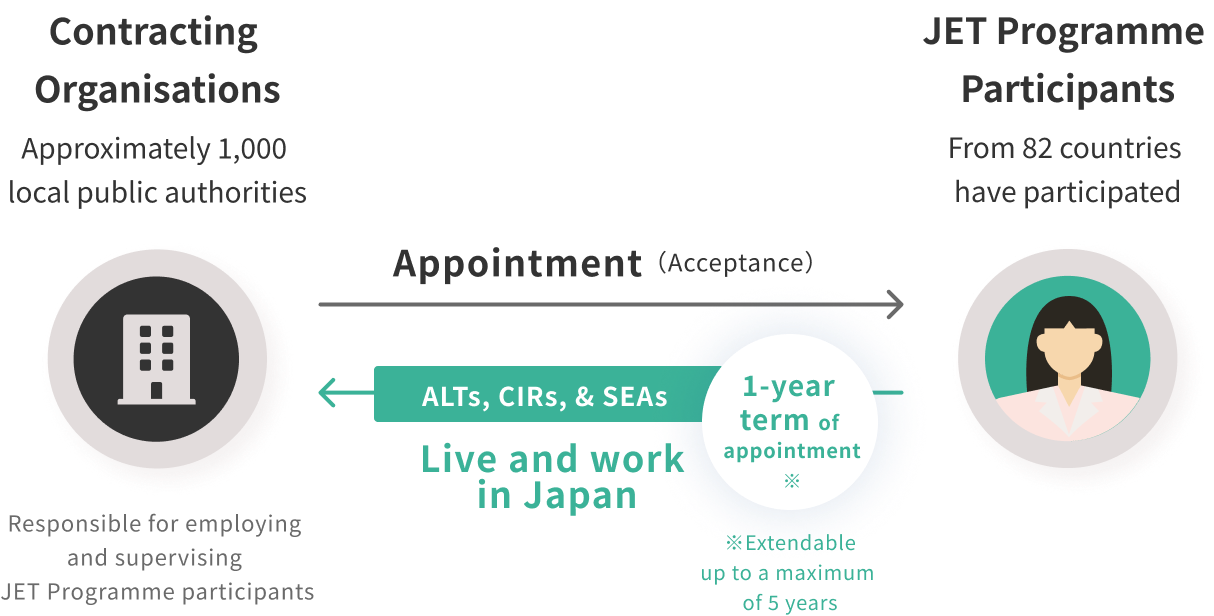
Through JET, Assistant Language Teachers (ALTs), Coordinators for International Relations (CIRs), and Sports Exchange Advisors (SEA) are recruited overseas and dispatched to local public bodies across Japan in an effort to foster better understanding of foreign cultures while also providing participants the chance to learn more about Japan.
CLAIR’s objective is to ensure that the JET Programme runs as smoothly and successfully as possible for the local authorities (contracting organisations) and individuals involved. In order to achieve this, CLAIR advises host prefectures and designated cities, contracting organisations, and participants.
CLAIR publishes the Contracting Organisation Manual (Ninyodantai-yo Manual) and the Questions & Answers Manual (Shitsugi Otoshu) for contracting organisations. In addition, CLAIR offers training and advice about handling JET Programme matters and dealing with cross-cultural issues through seminars for contracting organisations, Prefectural Advisors, and other officers.
Furthermore, CLAIR plans and runs numerous conferences for JET Programme participants. Likewise, participants are able to take advantage of a wide variety of publications produced and distributed by CLAIR.
CLAIR employs 13 Programme Coordinators (PCs), all former JET participants, 9 of whom are in the Department of JET Programme Management. These PCs serve as an additional point of contact for JET Programme participants and can answer questions or concerns about matters related to living and working in Japan.
Main duties of CLAIR’s Department of JET Programme Management include:
Main duties
- Overseeing correspondence with the Ministries involved with recruitment and selection of new JET participants.
- Placing JET Programme participants in contracting organisations after being notified of successful applicants by the Ministry of Foreign Affairs.
- Conducting promotional activities regarding the JET Programme.
- Providing assistance and guidance to contracting organisations.
- Coordinating the reappointment process between participants and contracting organisations.
- Preparing and implementing orientations and conferences such as Post-Arrival Orientation, CIR and SEA Mid-Year Seminars, and the After JET Conference.
- Providing support for local ALT Skill Development Conferences.
- Preparing training materials such as Japanese language course study CDs and textbooks and implementing Japanese language training for participants.

Ministry of Internal Affairs and Communications(MIC)
TThe Ministry of Internal Affairs and Communications is involved with the JET Programme in countless ways, most notably in administrative areas, such as calculating financial resources and determining acceptance guidelines for each participating country.
After consulting with the Ministry of Foreign Affairs (MOFA), the Ministry of Education, Culture, Sports, Science and Technology (MEXT), and CLAIR, MIC then creates acceptance guidelines for each participating country and specifies acceptance numbers.
MIC also allocates local taxes to help cover a portion of Programme expenses such as each participant’s remuneration and travel expenses.
Main duties
- Formulating the ‘Country-Specific Recruitment Plans’, which set the number of participants recruited from each country
- Providing financial support to local governments (through the Local Allocation Tax system)

Ministry of Foreign Affairs(MOFA)
The Ministry of Foreign Affairs is the first line of contact for JET Programme participants. Based on the acceptance guidelines for each country, MOFA recruits and selects participants through its overseas embassies and consulates.
Through these overseas embassies and consulates, MOFA runs information sessions for interested applicants, reviews applications, holds interviews, and notifies successful candidates. MOFA also provides essential information for new JET Programme participants about how to embark upon the life-changing journey to Japan. Pre-departure orientations and Q&A sessions help to ease anxieties and ensure that new participants can begin the JET programme fully prepared.
MOFA’s involvement does not stop there. When JET Programme participants return to their home countries, MOFA often sponsors a “welcome back” reception and works closely with the local JETAA (JET Alumni Association) to see that the friendships and ties that participants made in Japan remain strong and true.
MOFA works together with the other ministries and CLAIR on the JET Programme in efforts to raise social and cultural awareness of Japan and all things Japanese.
Main duties
- Publicity, recruitment, and selection carried out through Japan’s overseas embassies and consulates
- Conducting pre-departure orientations for new JETs
- Providing support to JETs after completing the programme

Ministry of Education, Culture, Sports, Science and Technology(MEXT)
The Ministry of Education, Culture, Sports, Science and Technology is the Japanese authoritative body on all matters relating to education. Although the activities and duties of MEXT are all-encompassing within the realm of education, JET Programme participants will see MEXT most with regards to orientations, seminars, and teaching guidance.
MEXT takes a proactive approach to helping ALTs by providing seminars and workshops at all JET Programme conferences. MEXT also provides school education training and guidance to ALTs.Another fundamental role of MEXT is to evaluate and construct the education curriculum, implement policies, and set education standards and texts. These policies and standards directly affect the classrooms where ALTs teach.
ALTs have the opportunity to participate in a direct opinion exchange with MEXT (as well as the other Ministries and CLAIR) every other year during the ALT Opinion Exchange.
Main duties
- Providing training, guidance, and advice for Assistant Language Teachers (ALTs) through post‑arrival orientations and various school‑education seminars. (Sports Exchange Advisors (SEAs) are overseen by the Japan Sports Agency)