


The JET Programme was started in 1987 with the purpose of increasing mutual understanding between the people of Japan and the people of other nations. It aims to promote internationalisation in Japan’s local communities by helping to improve foreign language education and developing international exchange at the community level.
Since its inception, the JET Programme has seen significant growth, from its original 848 participants from 4 countries in 1987, to 5,933 participants from 54 countries (as of 2025).
There are currently approximately 1,000 local government organisations, including 47 prefectures and 18 designated cities which host JET participants.
Participation Trends Over Time
2002: Highest number of participants recorded
6,273

2025: Current number of participants
5,933
Since 1987: Total number of participants
80,862


Participation Trends Over Time
※ Hover over to see the year and number of participants.
Reached 6,000 participants
Highest number of participants: 6,273
Reached 3,000 participants
20104,334 participants
As of 2024:
5,851 participants
Note: This chart uses fiscal years, which run from 1 April to 31 March.
| 1987 | 1988 | 1989 | 1990 | 1991 | 1992 | 1993 | 1994 | 1995 | 1996 |
|---|---|---|---|---|---|---|---|---|---|
| 848 | 1,443 | 1,987 | 2,284 | 2,874 | 3,325 | 3,785 | 4,185 | 4,628 | 5,032 |
| 1997 | 1998 | 1999 | 2000 | 2001 | 2002 | 2003 | 2004 | 2005 | 2006 |
| 5,332 | 5,691 | 5,835 | 6,078 | 6,190 | 6,273 | 6,226 | 6,103 | 5,853 | 5,508 |
| 2007 | 2008 | 2009 | 2010 | 2011 | 2012 | 2013 | 2014 | 2015 | 2016 |
| 5,119 | 4,682 | 4,436 | 4,334 | 4,330 | 4,360 | 4,372 | 4,476 | 4,786 | 4,952 |
| 20017 | 20018 | 20019 | 2020 | 2021 | 2022 | 2023 | 2024 | 2025 | 2026 |
| 5,163 | 5,528 | 5,761 | - | - | 5,723 | 5,831 | 5,861 | 5,933 | - |
Timeline of Our History
The Beginning of the JET Programme

The Japan Exchange and Teaching (JET) Programme began in 1987, welcoming 848 inaugural participants from four countries—the United States, the United Kingdom, Australia, and New Zealand.
Among them, 35 participants served as Coordinators for International Relations (CIR), working in local government offices to promote international exchange. The remaining 813 participants worked as Assistant Language Teachers (ALT), supporting foreign language instruction at public junior and senior high schools.
To support their transition into life and work in Japan, participants took part in Post-Arrival Orientation and Mid-Year Seminars, designed to help them begin their roles smoothly and continue developing their skills throughout the year.
JET programme started, 848 Participants from 4 Countries
- Inaugural JET Programme participants arrived from the United States, the United Kingdom, Australia, and New Zealand

- 35 as Coordinators for International Relations (CIR) to work in local public entities and 813 as Assistant Language Teachers (ALT) to teach at public junior and senior high schools.
- Post-Arrival Orientation and Mid-Year Seminars held for the first time


1,443 Participants from 6 Countries
- Canada and Ireland added as participating countries


1,987 Participants from 8 Countries
- Newly including Germany and France (German and French included in the targeted languages)
- Expanded programme languages to include German and French; Germany and France added as participating countries
- The JET Alumni Association (JETAA) was established for former JET participants (Initially 37 chapters → 2013: 52 chapters)
- Started seminars for participants who choose to recontract for the following year


2,284 Participants from 8 Countries
2,874 Participants from 8 Countries
3,325 Participants from 9 Countries
- Participation exceeded the initial target of 3,000 people
- China added as a participating country
- Established the Counselling System Committee (CSC), comprised of three (four at present) professional counselors
- Dispatched Prefectural Advisers (PA) to organisations to give advice on the establishment and management of a counselling system for the JET Programme

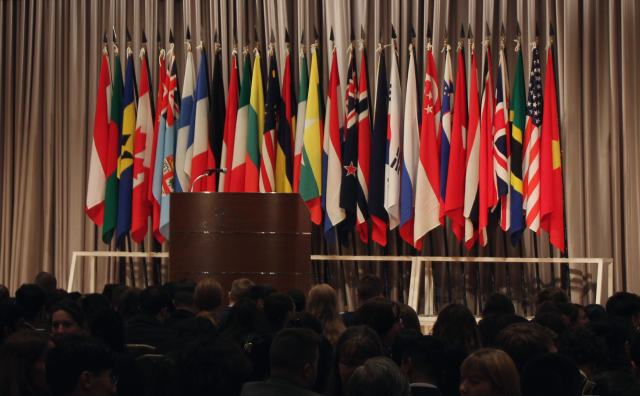
3,785 Participants from 10 Countries
- South Korea added as a participating country

4,185 Participants from 11 Countries
- Expanded the programme roles with the introduction of Sports Exchange Advisers (SEA)
- Introduced Japanese language seminars
- Russia added as a participating country


4,628 Participants from 15 Countries
5,032 Participants from 18 Countries
5,332 Participants from 27 Countries
- Started the Conferences for Returning JETs
- Introduced the merit-rating system
5,691 Participants from 34 Countries
- Expanded programme languages to include Chinese and Korean
- Started supporting JETAA activities
5,835 Participants from 37 Countries
- Started seminars for contracting organisations
6,078 Participants from 39 Countries
- Achieved target of 6,000 participants
- Conducted an appraisal survey
6,190 Participants from 39 Countries
- Started supporting the organisation of counselling sessions by prefecture
- Started developing Self-Support Group Leaders (SGL), counsellors for the increasing number of JET participants from non-English countries, selected SGLs for each language
- Started supporting regional meetings of JETAA
6,273 Participants from 38 Countries (Record Highest)
- Created Elementary School Specialist ALT position (20 ALTs in the first year)
- Established the position of Specialist PA for those who have been participating in the JET Programme for more than three years
- Increased the upper age limit from "younger than 35″ to "younger than 40″

6,226 Participants from 40 Countries
6,103 Participants from 41 Countries
5,853 Participants from 44 Countries
- Expanded programme languages to include Russian
5,508 Participants from 44 Countries
5,119 Participants from 41 Countries
- First-year ALTs allowed to become Elementary School ALTs provided a high Japanese ability
- Third-year participants allowed to reappoint with their current contracting organisation if the contracting organisation deems them outstanding and offers them reappointment
- Specialist PA position eliminated and Elementary School Specialist ALT title returned to ALT
4,682 Participants from 38 Countries
4,436 Participants from 36 Countries
4,334 Participants from 36 Countries
4,330 Participants from 39 Countries
4,360 Participants from 40 Countries
4,372 Participants from 40 Countries
4,476 Participants from 42 Countries
4,786 Participants from 43 Countries
4,952 Participants from 40 Countries
5,163 Participants from 44 Countries
5,528 Participants from 54 Countries
5,761 Participants from 57 Countries
Irregular Arrivals
- Irregular arrivals due to border restrictions arising from the COVID-19 pandemic
5,723 Participants from 50 Countries
5,831 Participants from 50 Countries
5,861 Participants from 51 Countries
5,933 Participants from 54 Countries